I recently subscribed to OpenCode Go, a subscription that gives you access to several open source models designed for coding, at a much lower cost than traditional alternatives. You pay $5 for the first month and then $10 per month, and with that you get access to models like GLM, Kimi, Qwen, MiniMax, MiMo, and DeepSeek.
What exactly is OpenCode Go?
OpenCode Go is a subscription plan created by OpenCode that bundles several open source models under a single API KEY, with a fixed monthly price instead of per-token billing.
Included models
The list of models has grown over time and currently includes, among others:
- GLM-5.2 / GLM-5.1
- Kimi K2.7 Code / Kimi K2.6
- Qwen3.7 Max / Qwen3.7 Plus / Qwen3.6 Plus
- DeepSeek V4 Pro / DeepSeek V4 Flash
- MiniMax M3 / MiniMax M2.7
- MiMo-V2.5 / MiMo-V2.5-Pro
OpenCode notes that this list may change, so it's worth checking the official documentation from time to time.
Limits
The subscription has 3 limits: daily, weekly, and monthly, very similar to how Claude works. The daily limit resets every 5 hours.
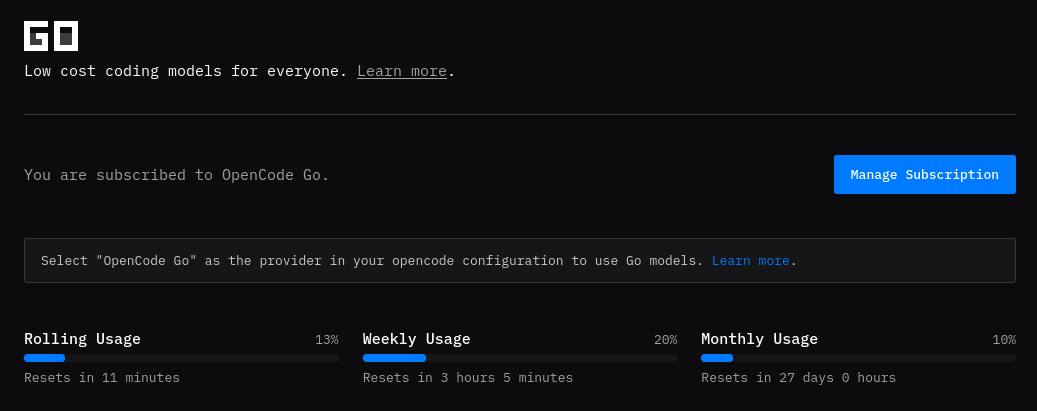
OpenCode Go subscription limits
An interesting detail is that these limits aren't measured in number of requests, but in a dollar-equivalent of usage. This means that with a cheap model like Qwen3.6 Plus you can make far more requests within the same 5-hour window than with a more expensive model like GLM-5.1.
Connecting with OpenCode
To connect your subscription you need to run the /connect command, choose the OpenCode Go provider, and paste the API key you generated in your OpenCode dashboard. Once connected, you can use /models to pick the model you want to use in each session, for example glm-5.1 or kimi-k2.6.
Is it worth it compared to proprietary models?
The most obvious comparison is against something like Claude, which costs $20 a month on its basic plan. OpenCode Go doesn't compete at the same quality level as frontier models (Claude Opus, GPT, Gemini Pro), but the gap has narrowed quite a bit: in recent coding benchmarks, models like Qwen3.7 Max or DeepSeek V4 Pro perform relatively close to frontier models, at a fraction of the cost per token.
Don't expect the same level of reasoning as a top-tier flagship model, but for everyday work the performance is more than enough, and the savings are significant.
Who does it make the most sense for?
- Developers who were already managing several separate API keys (DeepSeek, Qwen, etc.) and want to simplify down to a single subscription.
- Those who already pay for a main tool (Claude Code, Cursor, Codex) and want a cheap secondary model for less critical tasks.
- People who are just getting started with AI coding agents and don't want to commit to an expensive plan from day one.
My personal experience
In my personal experience, I recommend it wholeheartedly. It's one of the most affordable options on the market and, at the same time, of very good quality. It also offers the first month at half price, and from the second month onward it remains quite affordable compared to alternatives like Claude, which costs $20 a month.
My current workflow is to use a cheap model (DeepSeek V4 Flash or Qwen Plus) for quick, low-risk tasks, and reserve GLM or Kimi for whatever genuinely requires more reasoning power. That way I stretch the 5-hour limits much further without getting stuck mid-session.
My recommendation is to take advantage of the promotion and try the first month for just $5. It's a low-stakes bet, and if it doesn't convince you, you won't lose much by trying it for a month.